

 For this group consist: narcissus anemone Anemone narcisiflora, alpine club-moss Diphasium alpinum, Hypochoeris uniflora. Among the plant species present in BNP 66 species are protected by the law (58 species strictly protected). The proportion of synantropic plant species is relatively low and makes up only 10% of the total number of species, which gives local flora fairly natural character. The world of lower plants is very rich and interesting. There have been recorded about 300 species of lichens, 200 species of mosses and numerous species of fungi. One of the most interesting species is Pleurotus vetlinianus, which occur only in the Bieszczady Mts.
The vertical zonation in the Bieszczady has a unique character. Three climatic-vegetation zones can be distinguished:
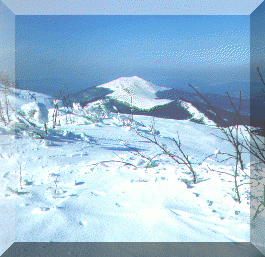
1. foothills zone (up to 500 m a.s.l.), 2. lower mountain decidous forest zone (500-1150 m a.s.l.) and 3. mountain grassland zone (above 1100-1150 a.s.l. up to 1346 m a.s.l.). Although mountain grassland zone is present, neither the upper forest spruce zone nor the dwarf pine zone occurs between it and the lower mountain forest zone. This phenomenon is regarded as a result of the climatic conditions and anthropogenic pressure in the past ages.The uppermost mountain grassland areas covered by specific alpine and subalpine meadow zone called "polonina". Around 90 % of BNP is covered by forest. The rest of the park is covered by mountain meadows (po3oniny), and non-forest associations in lower altitude ("country of valleys"). Seventy-five plant communities (15 forest, 60 non-forest) have been recorded in the BPN so far. Several of them: Pulmonario-Alnetum viridis, Aceri-Fagetum, Astrantio-Knautietum, Nardetum carpaticum orientale, Poo-Deschampsietum, Vaccinietum pocuticum are regarded as endemic.
For this group consist: narcissus anemone Anemone narcisiflora, alpine club-moss Diphasium alpinum, Hypochoeris uniflora. Among the plant species present in BNP 66 species are protected by the law (58 species strictly protected). The proportion of synantropic plant species is relatively low and makes up only 10% of the total number of species, which gives local flora fairly natural character. The world of lower plants is very rich and interesting. There have been recorded about 300 species of lichens, 200 species of mosses and numerous species of fungi. One of the most interesting species is Pleurotus vetlinianus, which occur only in the Bieszczady Mts.
The vertical zonation in the Bieszczady has a unique character. Three climatic-vegetation zones can be distinguished:
1. foothills zone (up to 500 m a.s.l.), 2. lower mountain decidous forest zone (500-1150 m a.s.l.) and 3. mountain grassland zone (above 1100-1150 a.s.l. up to 1346 m a.s.l.). Although mountain grassland zone is present, neither the upper forest spruce zone nor the dwarf pine zone occurs between it and the lower mountain forest zone. This phenomenon is regarded as a result of the climatic conditions and anthropogenic pressure in the past ages.The uppermost mountain grassland areas covered by specific alpine and subalpine meadow zone called "polonina". Around 90 % of BNP is covered by forest. The rest of the park is covered by mountain meadows (po3oniny), and non-forest associations in lower altitude ("country of valleys"). Seventy-five plant communities (15 forest, 60 non-forest) have been recorded in the BPN so far. Several of them: Pulmonario-Alnetum viridis, Aceri-Fagetum, Astrantio-Knautietum, Nardetum carpaticum orientale, Poo-Deschampsietum, Vaccinietum pocuticum are regarded as endemic.
 Among the large herbivorous, the red deer has a high population of 5-7 individuals per 100 ha. The European bison was reintroduced to the Bieszczady toward the end of the 1960. The population of bison has adapted itself successfully to the natural conditions of the park. At present in the herd existing in the park there are 20 individuals of bison. There are also populations of roe deer, wild boar and a few individuals of elk. The park has also successfully reintroduced of the beaver. For the last few years a herd of Hucul horses has been bred in the park in order to maintain this typical of this area old rare breed.
The Park is a paradise for bird-watchers. Extremely interesting and valuable groups of birds are birds of prey such as: golden eagle Aquila chrysaetos, lesser spotted eagle Aquilla pomarina, peregrine falcon Falco peregrinus, short toed eagle Circaaetus gallicus, booted eagle Hieraeetus pennatus, honey buzzard Pernis apivorus, and owls: eagle owl Bubo bubo and Ural owl Strix uralensis. On the mountain grassland are nesting alpine bird species like: water pipit Anthus spinoletta, Alpine accentor Prunella collaris and rock thrush Monticola saxatilis.
Another curiosity among animals is the Aesculapian snake Elaphe longissima, present only a few exist certain locations of Poland; the largest population inhabits a species reserve along the San river corridor, north from BNP border.
The fauna of invertebrates of the Bieszczady Mts. has clear Eastern-Carpathian character. Numerous species typical for the Eastern Carpathians one can find among insects, too.
Among the large herbivorous, the red deer has a high population of 5-7 individuals per 100 ha. The European bison was reintroduced to the Bieszczady toward the end of the 1960. The population of bison has adapted itself successfully to the natural conditions of the park. At present in the herd existing in the park there are 20 individuals of bison. There are also populations of roe deer, wild boar and a few individuals of elk. The park has also successfully reintroduced of the beaver. For the last few years a herd of Hucul horses has been bred in the park in order to maintain this typical of this area old rare breed.
The Park is a paradise for bird-watchers. Extremely interesting and valuable groups of birds are birds of prey such as: golden eagle Aquila chrysaetos, lesser spotted eagle Aquilla pomarina, peregrine falcon Falco peregrinus, short toed eagle Circaaetus gallicus, booted eagle Hieraeetus pennatus, honey buzzard Pernis apivorus, and owls: eagle owl Bubo bubo and Ural owl Strix uralensis. On the mountain grassland are nesting alpine bird species like: water pipit Anthus spinoletta, Alpine accentor Prunella collaris and rock thrush Monticola saxatilis.
Another curiosity among animals is the Aesculapian snake Elaphe longissima, present only a few exist certain locations of Poland; the largest population inhabits a species reserve along the San river corridor, north from BNP border.
The fauna of invertebrates of the Bieszczady Mts. has clear Eastern-Carpathian character. Numerous species typical for the Eastern Carpathians one can find among insects, too.
 The protection is enable because of low density of human population (less than 4 persons/sq. km).