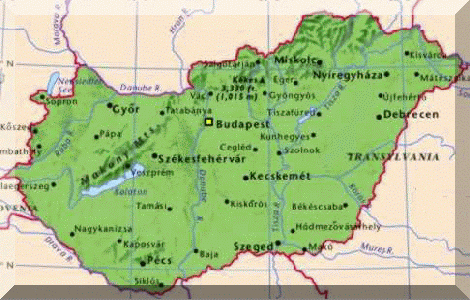
Country in central Europe, bounded N by
the Slovak Republic, NE by Ukraine, E by
Romania, S by Yugoslavia and Croatia,
and W by Austria and Slovenia.
• government
Under the terms of the `transitional
constitution´ adopted Oct 1989, Hungary is
a unitary state with a one-chamber,
386-member legislature, the national
assembly (Orszaggyules). Its members are
elected for four-year terms under a mixed
system of proportional and direct
representation: 176 are directly elected (on
a potential two-ballot run-off basis) from
local constituencies; 152 are from regional,
county, and metropolitan lists on a
proportional basis; and 58 are elected
indirectly from party-nominated national
`compensation´ lists designed to favour
smaller parties. Free competition is
allowed in these elections. The national
assembly elects a president as head of
state and chief executive for a maximum of
two five-year terms, and a council of
ministers (cabinet) headed by a prime
minister. Since 1989 opposition parties
have been able to register freely and
receive partial state funding. A
constitutional court has also been
appointed to serve as a watchdog.
• history
Inhabited by Celts and Slavs, the region
became a Roman province. After the
Roman era it was overrun at the end of the
4th century AD by Germanic invaders and
by Asians who established a Magyar
kingdom in the late 9th century, under a
chief named Árpád. St Stephen (ruled
997-1038) was Hungary's first king; he
established a kingdom 1001 and converted
the inhabitants to Christianity. After the
Árpádian line died out, Hungary was ruled
1308-86 by the Angevins, and
subsequently by other foreign princes.
Turkish rule
From 1396, successive rulers fought to
keep out Turkish invaders but were finally
defeated at Mohács 1526, and the south
and centre of the country came under
Turkish rule for 150 years, while the east
was ruled by semi-independent Hungarian
princes. By the end of the 17th century the
Turks had been driven out by the
Habsburgs, bringing Hungary under
Austrian rule. After 1815 a national
renaissance began, under the leadership of
Louis Kossuth. The revolution of 1848-49
proclaimed a Hungarian republic and
abolished serfdom, but Austria suppressed
the revolt with Russian help.


 Country in central Europe, bounded N by
the Slovak Republic, NE by Ukraine, E by
Romania, S by Yugoslavia and Croatia,
and W by Austria and Slovenia.
Country in central Europe, bounded N by
the Slovak Republic, NE by Ukraine, E by
Romania, S by Yugoslavia and Croatia,
and W by Austria and Slovenia.